
.jpeg "Gas Cooker Brands in Nigeria (2026): Flipbz Market Report on Household Demand, Pricing and Consumer Preferences")
Written By: Flipbz.org
Gas cookers sit at an unusual crossroads in the Nigerian household economy, a durable goods category whose growth is fundamentally capped by how many homes actually use cooking gas at all. Unlike detergent, toothpaste or biscuits, where nearly every household is already a participant, the gas cooker market in Nigeria is still, in many ways, a market of aspiration rather than universal ownership, one where infrastructure, affordability and fuel access shape demand as much as brand preference does.
The Flipbz Gas Cooker Brands in Nigeria (2026) Market Report draws on publicly available data from the National Bureau of Statistics (NBS), the Standards Organisation of Nigeria (SON), the Nigerian Midstream and Downstream Petroleum Regulatory Authority (NMDPRA), and industry research platforms, combined with Flipbz's own market analysis. The report does not rank or promote individual brands but examines the forces shaping pricing, brand loyalty and competition across Nigeria's gas cooker sector.
A Market Built on Limited Fuel Access
Nigeria's gas cooker story cannot be separated from the country's slow and uneven transition to cooking gas itself. Unlike detergent or toothpaste, where the entire population is a potential buyer, gas cookers depend on a smaller base of households that have already adopted LPG as a cooking fuel. According to the 2024 Nigeria Residential Energy Demand Side Survey, only 19.4% of households in Nigeria use Liquefied Petroleum Gas for domestic purposes, meaning about one in every five households use LPG. The same survey found that approximately 67.8% of Nigerian households rely on fuelwood as a source of energy, underscoring just how much room the category still has to grow, and how much of Nigeria remains outside the addressable gas cooker market entirely.
Even within that smaller LPG using population, adoption has been a slow, hard won climb. Industry stakeholders note that some 12 million households currently access LPG, representing a marked improvement from a few years ago, but the figure is grossly insufficient for over 200 million population. The barriers to wider adoption have remained remarkably consistent over the years. Research into rural LPG adoption found that major constraints limiting respondents' choice of LPG were lack of funds to purchase LPG, scarcity of gas at skid plants, and high cost of refilling gas.
Supply side conditions, however, have shifted meaningfully in recent years, which matters directly for gas cooker demand since cheaper, more available cooking gas tends to pull more households into the category. In 2025, local refineries and gas processing plants, led by the Dangote Petroleum Refinery and NLNG Limited, supplied 87% of Nigeria's domestic Liquefied Petroleum Gas, significantly reducing the country's dependence on imports, a sharp turnaround from just two years earlier when imported cooking gas accounted for about 47% of total consumption in 2023.
The Brands on Nigerian Shelves Today
Nigeria's gas cooker market is dominated by a mix of long established local heritage brands and imported names that have built distribution networks across the country's electronics and appliance retail chains. Industry tracking of the category places market leaders as Nexus at 20%, Scanfrost at 18%, and Midea at 15% of the gas cooker market, with Bruhm, Polystar, Binatone and Skyrun rounding out a competitive second tier.
Scanfrost has arguably built the deepest cultural footprint of any name in the category. Though it started with UK roots, Scanfrost has since become a proudly Nigerian household name, trusted by generations since the 1980s and 90s, and if you grew up in Nigeria, chances are your family had a Scanfrost standing fan, cooker, or deep freezer quietly doing the hard work in the background. The brand's move into cookers specifically came later in its history. In 2007, Scanfrost extended its product portfolio to a range of household appliances including cookers, microwave ovens, refrigerators, air conditioners, washing machines and kitchen appliances, while strengthening the existing portfolio. That positioning has held for nearly two decades since. With over 35 years of national experience, the brand has built loyalty around affordability and durability, and Scanfrost gas cookers are among the most rated in the market, with their ready availability and easy affordability making them more popular in the modern market.
Bruhm and Polystar have carved out their own niches within the mid tier and premium segments respectively. Reviews of the category note that Bruhm's 3 gas plus 1 electric cooker offers three high efficiency burners and an extra electric hotplate, with the oven's thermostat and double glass door working together for consistent baking, brass burners and sturdy cast iron pan stands handling large cookware, and tempered glass lid and push start ignition rounding out a combination cooker well regarded for its solid construction and versatile design. Polystar, meanwhile, has positioned itself toward the higher end of the built in hob segment, with Polystar's 5 burner built in hob engineered for serious cooking, featuring a sleek tempered glass surface, five brass burners including a powerful wok burner, heavy duty cast iron pan supports, and built in flame failure safety devices that cut gas flow if the flame goes out unexpectedly, making it a premium choice for upgrading any kitchen with a durable, high end stove.
NASCO, one of Nigeria's oldest indigenous manufacturing groups, brings a different kind of heritage to the appliance space more broadly, having built its industrial base long before most competitors entered the market. A story that began with a dream in 1963 has today become an African legacy, with NASCO starting operations that year through the establishment of a jute bag factory in the central city of Jos, Nigeria, the very first in sub Saharan Africa. Binatone, distributed locally by Global Appliances Nigeria Limited, has also expanded its kitchenware footprint through partnership, with the distributor entering into a strategic tie up in 2025 to broaden its offering across cooking related categories.
Why Table Top and Small Burner Formats Matter So Much
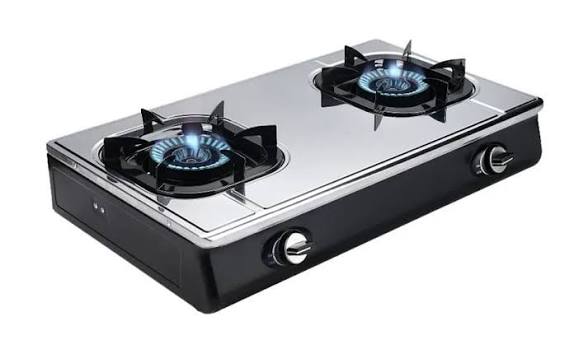
As with several other household categories in Nigeria, affordability has pushed manufacturers to build out smaller, entry level formats designed for compact kitchens and constrained budgets. Retail assortments across major appliance platforms reflect this segmentation clearly, with categories spanning full standing cookers with ovens down to compact 2 burner table top units, glass top burners and portable gas stoves designed for smaller households or secondary cooking stations.
This format diversity matters because Nigeria's gas cooker buyers are not a uniform group. Urban households upgrading from single burner setups often start with smaller table top units before eventually moving to full standing cookers with ovens and grills, a pattern that mirrors the broader progression path across many of Nigeria's durable goods categories, where affordability tiers act as stepping stones toward fuller featured purchases as income allows.
What Nigerian Consumers Consider Before Choosing a Gas Cooker Brand
Price and Burner Configuration
Affordability and the number of burners remain the deciding factors for most households, with buyers weighing whether a 2 burner table top unit suffices or whether a full 4 to 5 burner standing cooker with oven and grill better matches family cooking needs.
Build Quality and Rust Resistance
Given Nigeria's humid climate in many regions, durability and rust resistance are recurring concerns, with features like stainless steel tops and anti rust protection cited frequently as reasons for brand preference, particularly for standing cookers expected to last many years.
Oven and Grill Functionality
Consumers increasingly value combined cooking and baking capability in a single unit, with double glass oven doors, adjustable thermostats and grill functions cited as meaningful differentiators between competing standing cooker models.
Safety Certification
Given the potential hazards associated with gas appliances, certification has become a genuine safety consideration for Nigerian buyers, particularly around the cylinders that power these cookers. SON has repeatedly urged Nigerian consumers to patronise only SON certified LPG and other cylinders with necessary markings, to safeguard their homes, offices and surroundings from avoidable fire incidents from substandard cylinders. The regulator has also been explicit about the dangers of improper cylinder use with cooking equipment, warning that it is highly dangerous to use cylinders of higher capacities like 12.5 kg and above as camping gas where burners are fitted directly on top, since having a cooking pot on top of such a cylinder stands the risk of tilting over, and it is highly dangerous to subject the high volume of LPG in a high capacity cylinder to heat from a cooker sitting directly on top of it.
The Rise of Informed Gas Cooker Buyers
Nigerian households, increasingly cautious amid tightening budgets and safety concerns, are researching more before they buy. Common searches include:
Best gas cooker brands in Nigeria
Scanfrost vs Nexus vs Midea comparison
Cheapest gas cooker prices in Nigeria
Best table top gas cooker for small kitchens
Gas cooker price list 2026
Is my gas cylinder SON certified
This growing research culture, amplified by social media discovery and appliance comparison platforms, is reshaping brand consideration in ways traditional advertising alone no longer fully controls.
Challenges Facing Nigeria's Gas Cooker Industry
Import dependency remains a defining structural vulnerability for the category. Nigeria's cooking appliance market shows a high dependence on imports, with China serving as the dominant supplier, and from 2020 to 2024 the market operated within a global context where China was the overwhelming production leader, accounting for approximately 80% of global output. This exposes local pricing directly to shipping costs, exchange rate volatility and global supply shocks largely outside the control of Nigerian retailers or distributors.
Low LPG adoption continues to cap the addressable market for gas cookers overall. With only a fraction of households using cooking gas at all, manufacturers are effectively competing for a limited and slowly expanding customer base, one whose growth depends as much on national energy policy and fuel affordability as on appliance marketing.
Safety and certification gaps around cylinders, even where the cookers themselves are legitimate, remain an ongoing regulatory concern. Enforcement actions have uncovered significant volumes of non compliant equipment entering the country, with one seizure alone involving a 40 foot container loaded with substandard LPG cylinders valued at N38 million, cylinders that failed to meet safety requirements and posed a threat to human lives and property.
Power supply and infrastructure inconsistency also shapes appliance design choices industry wide, pushing manufacturers toward products engineered for Nigeria's specific conditions rather than simply importing standard global models.
Market Outlook for 2026 and Beyond
Nigeria's broader household appliances market, of which gas cookers form a meaningful segment, is positioned for steady expansion. The Nigeria household appliances market was valued at USD 3.88 billion in 2025 and is expected to grow at a CAGR of 6.80% during the forecast period of 2026 to 2035 to reach a value of USD 7.49 billion by 2035. Within that broader appliance space, the specific large cooking appliance segment shows more modest but still positive momentum, with the Nigeria Large Cooking Appliance Market anticipated to register a CAGR of 2.65% during 2026 to 2034, with market size valued at USD 7.76 million in 2025 and projected to reach USD 9.82 million by 2034.
Underlying demand drivers remain consistent with patterns seen across Nigeria's broader durable goods economy. The Nigeria large cooking appliance market reflects a steadily developing consumer durables segment shaped by rapid urbanization, rising middle class households, and gradual improvements in residential infrastructure, with demand primarily driven by urban consumers seeking modern cooking solutions that offer efficiency, safety, and durability, even as traditional cooking methods remain common in rural areas. Growth is expected to remain measured rather than explosive. Growth remains moderate due to income constraints and power supply challenges, yet replacement demand and new housing developments continue to provide a stable demand base across major cities.
Continued improvement in domestic LPG supply is also expected to support gradual category expansion. With stakeholders projecting that domestic suppliers could further increase their share of the LPG market in the coming years, potentially eliminating the need for imports and strengthening Nigeria's energy security, gas cooker demand stands to benefit indirectly from a more stable and potentially cheaper cooking gas supply chain, assuming distribution and storage infrastructure keep pace.
Conclusion
Nigeria's gas cooker market in 2026 tells a story shaped less by fierce brand rivalry alone and more by the slow, steady expansion of the underlying LPG using population itself. Scanfrost, Nexus, Midea, Bruhm and Polystar anchor a competitive field built on affordability tiers ranging from compact table top units to full standing cookers with ovens and grills, while the category's real ceiling remains tied to how many more Nigerian households make the transition from fuelwood and kerosene to cooking gas. For manufacturers, the path forward will likely depend on continued investment in rust resistant, locally adapted designs, expanding affordable entry level formats, and reinforcing safety credentials around cylinder use, even as broader energy policy and improving domestic gas supply do much of the heavy lifting in growing the addressable market itself.
About this Report
The Flipbz Gas Cooker Brands in Nigeria (2026) Market Report is an independent editorial publication prepared using publicly available information from the National Bureau of Statistics (NBS), the Standards Organisation of Nigeria (SON), the Nigerian Midstream and Downstream Petroleum Regulatory Authority (NMDPRA) and industry research platforms, together with independent market analysis by Flipbz. It is intended to provide market insight and does not constitute purchasing advice.
Please register to comment.
With these components in place, your business...
SolidBase Builders Limited is a professionall...
PrimeStone Construction Nigeria Ltd is a well...
CrestRock Engineering Services Ltd is a scala...
Here is an optimized version of your Blade te...
Discover promising partnership opportunities in various industries.
Pitch Your Startup | Find Partners
.jpeg)





Comments