
.jpg "Charged and Ready: How the Power Bank Became Nigeria's Most Trusted Pocket Companion")
Written By: Flipbz.org
In a country where the national grid cannot be trusted to keep a phone alive past lunchtime, the power bank has quietly become as essential as the phone itself. This is not a category fighting for attention, it is one Nigerians already reach for daily, the real tension in 2026 sits somewhere else entirely, in the gap between what a power bank claims on its casing and what it actually delivers once NEPA disappears for the third time that week. This report, built on publicly available retail data, market intelligence and independent Flipbz analysis, examines the brands, pricing tiers and trust dynamics defining how Nigerians choose, use and increasingly distrust the mobile power devices keeping their lives connected.
A Category Nigerians Can No Longer Live Without
The power bank has crossed a line in Nigeria that most accessories never reach, it stopped being an accessory. Retailers describe it plainly, noting that in Nigeria's unpredictable power landscape, a reliable power bank is no longer a luxury, it's a necessity, driven by rising mobile phone use and the constant threat of dead batteries at the worst possible moment. Industry commentary frames the stakes even more directly for daily life, since if you live in Nigeria, you already know why power banks are not luxury, they're survival tools, between light issues, long commutes, and heavy daily phone use.
That survival framing shows up clearly in what people actually buy. The ten thousand milliamp hour capacity remains the most common entry point for everyday buyers, since this is the most popular capacity in Nigeria, and a 10000mAh power bank can charge most smartphones two times. But the market has also pushed hard toward bigger batteries for households facing longer outages, with premium models like Oraimo's higher capacity offering, its 27,000mAh battery, providing enough power to charge most smartphones multiple times before requiring a recharge, ideal for anyone living in areas with frequent power outages.
The Brands on Nigerian Shelves Today
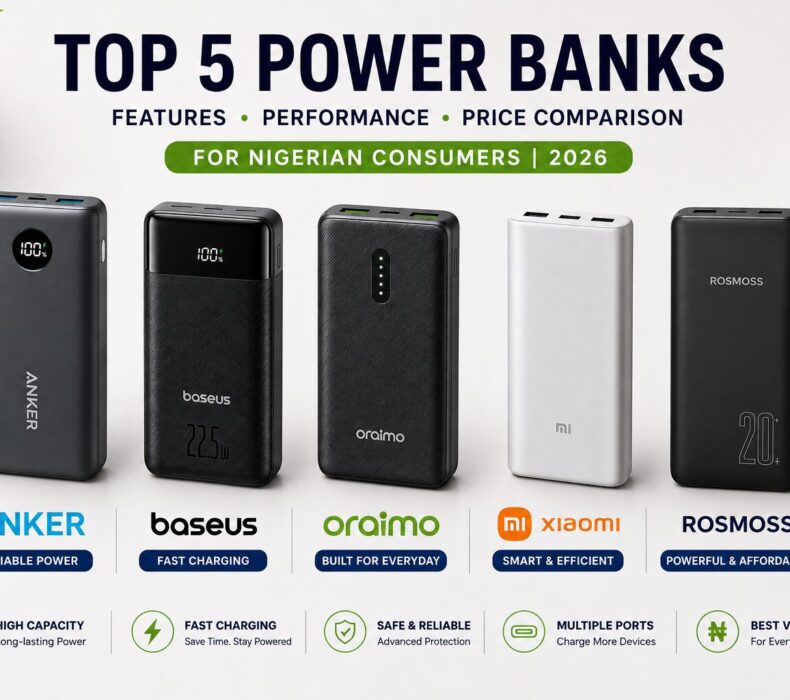
Nigeria's power bank shelf runs across three distinct tiers, and unlike some appliance categories, brand loyalty here is unusually strong because trust is hard won and easily lost. Oraimo sits firmly at the top of the affordable tier, having built its identity around dependable value, since it has become one of Nigeria's most trusted mobile accessory brands, with its Traveler 3 Lite offering an excellent balance of battery capacity, affordability, and fast charging. One review summarised the brand's local reputation simply, noting Oraimo is popular for one reason, value that's not fake, with its higher capacity twenty thousand to thirty thousand milliamp hour class models common in Nigeria at friendly pricing compared to premium imports.
Anker occupies the premium end of the market, bought by Nigerians willing to pay significantly more for engineering confidence, since the brand is known for its multiple protection systems against overheating, overcharging, short circuits, and excessive voltage, helping protect both the power bank and connected devices. That premium pricing is real and consistent across retailers, with typical Anker pricing in Nigeria ranging from roughly twenty five thousand to forty five thousand naira, sometimes climbing toward seventy thousand naira for flagship high wattage models, a gap wide enough that most everyday buyers still default to cheaper alternatives.
Between these two sit a crowded field of mid tier and budget names that make up the bulk of actual daily sales, including Baseus, Xiaomi, Romoss, UGREEN, itel and New Age, brands one Nigerian buyer's guide summarised simply as among the most trusted power bank brands available in Nigeria, alongside Anker and Oraimo. Itel in particular has carved out a strong budget reputation, since Itel has become a strong competitor in Nigeria's budget electronics market by offering high capacity power banks at affordable prices, with its Power Pulse series supporting fast charging up to 22.5W at prices typically ranging between fifteen thousand and thirty thousand naira.
Why Trust, Not Just Capacity, Now Decides Which Power Bank Wins
Nigeria's power bank market carries a problem most categories do not, an epidemic of products that simply lie about what they contain. Regulators have confirmed the scale of this counterfeit economy is far larger than most consumers assume, since NAFDAC has raised an alarm that Chinese counterfeiters are now establishing manufacturing plants and logistics networks in Nigeria, with the counterfeit trade shifting from importing fake products from China to local production and distribution. The agency's enforcement numbers underline how serious this has become nationally, with NAFDAC confiscating and destroying regulated products worth more than N1.5 trillion during coordinated operations across Lagos and the south east, alongside sixty four convictions of counterfeiters secured between June 2025 and June 2026.
For power banks specifically, the deception usually hides in plain sight on the casing itself. Consumer guidance warns buyers directly about this trick, since most fake power banks especially the ones commonly sold locally usually have a very high capacity written on the shell, such as fifty thousand or even one hundred thousand milliamp hours, numbers that are almost never real. The danger goes beyond wasted money too, since a fake or substandard unit can cause hazard to a phone by damaging its battery or even catching fire in the process. This is precisely why established brand reputation carries so much weight in Nigeria's market, since safety conscious buyers increasingly treat a recognisable name as a genuine layer of protection rather than a marketing preference.
What Nigerian Consumers Consider Before Choosing a Power Bank
Genuine Versus Inflated Capacity
Buyers who have been burned once become far more careful the second time, actively checking for a proper brand name and realistic capacity claims rather than trusting a bare shell simply printed with the word "POWER BANK," a red flag experienced buyers now recognise instantly.
Fast Charging Compatibility
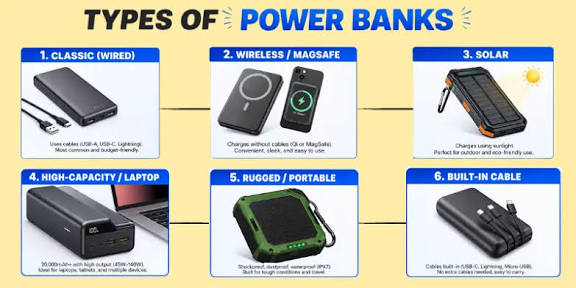
As phones themselves get faster charging chips, buyers increasingly shop for matching output, since modern power banks now support technologies such as USB Power Delivery and Quick Charge, with compatible units able to charge devices significantly faster than older, regular models.
Multi Device and USB C Support
Households charging several gadgets at once weigh port flexibility heavily, since many current models include USB C ports, multiple charging outputs, and in higher wattage cases enough power to charge laptops alongside phones and earbuds.
Price Versus Brand Assurance
Buyers openly weigh cost against confidence, some accepting that Samsung power banks can be pricey in Nigeria, but preferring the confidence of a big OEM brand, especially if they already use a phone from that same manufacturer.
Heat Safety During Charging
Experienced buyers now factor in real world conditions like Nigerian heat directly into brand choice, since decent budget models are generally fine for the price tier but demand caution, given that fast charging in hot rooms or under direct sun can affect performance and safety.
The Rise of Informed Power Bank Buyers
Nigerian consumers are researching power banks with growing sophistication before spending their money. Common searches now include:
Best power bank for constant power outages in Nigeria
Oraimo vs Anker vs Baseus power bank comparison
How to identify a fake power bank in Nigeria
Power bank price list 2026
Fastest charging power bank for Android and iPhone
Power bank that can charge a laptop
This research culture, fuelled heavily by Jiji and Jumia reviews, Nairaland safety threads and gadget blog comparisons, continues to shape which brands earn genuine first time buyer trust in a market crowded with lookalikes.
Challenges Facing Nigeria's Power Bank Industry
Counterfeit saturation remains the industry's most damaging problem, since fake units printed with inflated, unrealistic capacities continue to circulate widely, quietly eroding consumer confidence in the entire category rather than just the specific fake brand involved.
Regulatory enforcement is intensifying but still racing to catch up, since NAFDAC's own leadership has acknowledged that counterfeiters have shifted from importing fake goods to manufacturing them locally inside Nigeria, meaning fakes are now harder to trace at the border and easier to distribute undetected.
Currency exposure continues to widen the price gap between budget and premium tiers, since nearly all power bank components, lithium cells, charging chips and casings, are imported, meaning naira depreciation feeds directly into retail prices from five thousand naira budget units to premium models costing well over seventy thousand naira.
Market Outlook for 2026 and Beyond
Global demand for portable charging keeps climbing steadily, with the worldwide power bank market projected to reach approximately twenty billion dollars in 2026, continuing a multi year growth trend driven by rising smartphone dependency and remote work culture. Africa specifically stands out as the fastest expanding region within this global picture, since Africa is anticipated to register the highest compound annual growth rate of any region through 2031, a trend explicitly linked to the fact that six hundred million Sub Saharan Africans still lack reliable electricity, conditions that directly boost demand for portable charging solutions.
Nigeria sits at the center of that African growth story precisely because its power problems are so persistent. Regional analysts tie this growth directly to grid unreliability and mobile dependency, noting that unreliable grids and high mobile penetration continue to spur demand for portable charging across the continent. Product design is expected to keep evolving around exactly this reality, with newer components enabling laptop grade charging speeds from increasingly compact, pocket sized battery packs, a shift that should make higher wattage devices more accessible to ordinary Nigerian buyers over time.
Conclusion
Nigeria's power bank market in 2026 is not being built from a low ownership base, it is being fought over one repurchase at a time by brands trying to prove they are not the fake unit that let a customer down last year. Oraimo's everyday value, Anker's premium safety reputation, and a crowded middle tier of Baseus, itel, Xiaomi and Romoss all compete for a buyer who has likely already been burned once by a counterfeit. With NAFDAC's crackdown intensifying and genuine capacity now mattering more to shoppers than flashy marketing, the brands that win from here will be the ones that can prove, consistently and visibly, that what is printed on the shell is actually what sits inside the battery.
About this Report
The Flipbz Power Bank Brands in Nigeria (2026) Market Report is an independent editorial publication prepared using publicly available information from industry research platforms, retailer data and market intelligence sources, together with independent market analysis by Flipbz. It is intended to provide market insight and does not constitute purchasing advice.
Please register to comment.
With these components in place, your business...
SolidBase Builders Limited is a professionall...
PrimeStone Construction Nigeria Ltd is a well...
CrestRock Engineering Services Ltd is a scala...
Here is an optimized version of your Blade te...
Discover promising partnership opportunities in various industries.
Pitch Your Startup | Find Partners
.jpg)
.jpg)
.jpg)

Comments