
.jpeg "CBN Watchers Anticipate New Monetary Policy Signals")
Written By: Flipbz.org
Analysts Monitor Interest Rate Expectations As Inflation And Growth Pressures Persist
After holding rates steady for a second consecutive meeting amid Middle East driven uncertainty, all eyes now turn to the Central Bank of Nigeria's September gathering, as economists debate whether disinflation is durable enough to finally justify a rate cut.
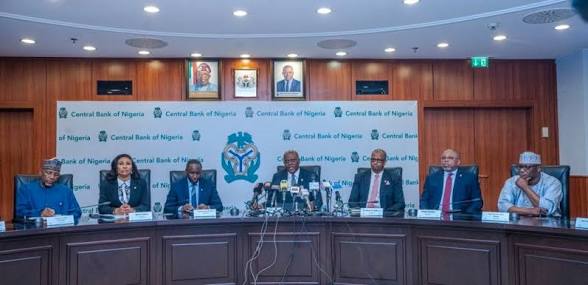
Nigeria's Central Bank has once again chosen caution over stimulus, holding its benchmark interest rate steady for the second consecutive meeting even as inflation shows tentative signs of easing. With the next Monetary Policy Committee meeting scheduled for September and economists split on how quickly rate cuts might resume, market watchers are parsing every statement from Governor Olayemi Cardoso for clues about when, and how, Nigeria's tightening cycle will finally give way to meaningful easing.
What Happened
The Monetary Policy Committee of the Central Bank of Nigeria retained the Monetary Policy Rate at 26.5 percent following its 306th meeting, held in Abuja on July 20 and 21, 2026. Cardoso disclosed that all eleven members of the committee attended the two day meeting, where they reviewed recent domestic and global economic developments before deciding to leave the benchmark rate unchanged. The committee also retained the Standing Facilities Corridor around the MPR at plus 50 and minus 450 basis points, while maintaining the Cash Reserve Requirement at 45 percent for deposit money banks, 16 percent for merchant banks, and 75 percent for non-TSA public sector deposits.
Explaining the decision, Cardoso said that while domestic economic indicators show resilience following past structural reforms, heightened global geopolitical uncertainties, particularly in the Middle East, continue to pose risks to energy prices and domestic inflation. He added that although headline inflation moderated marginally in June 2026, global uncertainties have heightened due mainly to the renewed hostilities in the Middle East, prompting the committee to prioritize stability over an early return to easing. Despite those risks, Cardoso maintained that the Nigerian economy has remained largely resilient to the external shocks.
This marks the second time this year the MPC has left rates unchanged, following an earlier hold in May. The committee's current posture represents a meaningful shift from the trajectory Nigeria had been on. The CBN delivered its first policy easing in February by reducing the Monetary Policy Rate by 50 basis points from 27 percent to 26.5 percent, before pausing at its May meeting, signalling that the fight against inflation was not yet fully won despite improving macroeconomic conditions. That February cut had followed an unprecedented tightening cycle, during which the CBN raised the benchmark rate six consecutive times, taking it from 18.75 percent to 27.50 percent in November 2024, under Cardoso's leadership since his appointment by President Bola Tinubu in 2023.
Speaking separately at the BusinessDay CEO Forum in Lagos on July 16, Cardoso revealed that although the CBN had expected to begin lowering interest rates after several months of disinflation, unexpected geopolitical shocks, particularly tensions arising from the conflict involving the United States and Iran, necessitated a more cautious approach. He later briefed the Senate Committee on Banking, Insurance and Other Financial Institutions on July 22, telling lawmakers that headline inflation rose from 15.06 percent in February to 15.93 percent in May before easing slightly to 15.91 percent in June, an outcome he described as demonstrating the effectiveness of the bank's monetary policy stance in containing second-round inflationary pressures.
The next MPC meeting is scheduled for September 21 and 22, 2026, a gathering already being treated by analysts as one of the most consequential of the year.
Why It Matters

For businesses and everyday borrowers, the practical consequence of the CBN's continued caution is straightforward: credit remains expensive. Analysts have noted that for businesses and SMEs, borrowing costs will remain restrictive, underscoring the need to look beyond interest rates for growth, a reality that has already surfaced in complaints from Nigeria's manufacturing sector over financing costs stifling expansion.
At the household level, the stakes are equally direct. One analyst observed that for households, the outcome means relief from inflation will remain gradual, especially with food inflation still running high in many states in the federation. That tension, between a central bank prioritizing long term price stability and a population contending with immediate cost of living pressures, sits at the heart of why every MPC decision now draws such intense public scrutiny.
Industry Context
Nigeria's currency and reserve position has strengthened considerably, providing the CBN with more room to maneuver, even if it has chosen not to use that room for rate cuts. Gross external reserves rose to $52.52 billion as of July 17, 2026, from $50.47 billion at the end of May, driven primarily by receipts from crude oil related taxes and third party inflows, a reserve level that now provides approximately 11 months of import cover, significantly exceeding the international benchmark of three months. Cardoso also told the Senate that Nigeria's banking recapitalisation programme had helped lenders raise N4.65 trillion in fresh capital, with 72.55 percent coming from domestic investors and 27.45 percent from foreign investors, describing it as one of the most successful recapitalisation exercises in the country's history.
Analyst forecasts for the rest of 2026 remain notably divided. The Chartered Institute of Bankers of Nigeria projected ahead of the July meeting that the CBN would hold its benchmark rate steady, while simultaneously revising its expected year end MPR to 25 percent and raising its average inflation forecast for the year to 15.5 percent from an earlier estimate of 12 percent. Standard Chartered Plc, meanwhile, projected that the CBN would cut interest rates by only 150 basis points in 2026, arguing persistent inflationary pressures would limit the pace of monetary easing. One economist quoted by BusinessDay summarized the prevailing market expectation directly: "We expect the MPC to hold the MPR at 26.50 per cent through H2 2026, adopting a cautious wait-and-see stance."
The geopolitical backdrop shaping these decisions has been unusually direct in its framing by the CBN itself. Cardoso identified the severe and prolonged escalation of the Middle East conflict as remaining the major risk to Nigeria's economic outlook, explaining that higher oil prices may strengthen reserves and government revenue, but they can simultaneously increase domestic prices, widen production costs, and place pressure on the naira if the import bill rises. That dual edged dynamic, in which the same global event can help and hurt Nigeria's economy at once, has become a defining feature of the CBN's current decision making calculus.
Longer term, the central bank has articulated an ambitious target. Cardoso reaffirmed the CBN's commitment to reducing inflation to single digits over the medium term through data-driven monetary policy and improved transmission of its policy decisions, while acknowledging that the bank had expected inflation to be firmly on course towards single digits by early 2027 after recording eleven consecutive months of disinflation, a trajectory since interrupted by the Middle East shock.
What Flipbz Thinks
Flipbz views the CBN's current holding pattern as a defensible, if uncomfortable, exercise in credibility management. Having invested heavily in disinflation since 2023, Cardoso's committee appears determined not to reverse course prematurely simply because one or two months of data showed marginal improvement, especially with an active geopolitical wildcard still unresolved. The bank's own framing, that tightening further could unnecessarily weaken domestic demand while cutting rates now would risk undermining progress already made in controlling inflation, reflects a genuinely difficult balancing act rather than simple indecision. The real signal to watch is whether the September meeting produces language suggesting the bank views recent global shocks as durably absorbed into the outlook, or whether Cardoso continues describing them as an active, ongoing risk. That framing shift, more than any single rate change, will tell markets when genuine easing is likely to resume.
What Consumers & Investors Should Watch
Consumers and small business borrowers should watch closely for any change in tone from the CBN heading into the September 21 and 22 meeting, particularly regarding food inflation trends and Middle East developments, both of which Cardoso has identified as central to the committee's calculus. Investors should track the widening gap between institutional forecasts, with CIBN and Standard Chartered offering meaningfully different projections for where rates land by year end, as a signal of just how uncertain the path to easing has become. Continued growth in external reserves and further clarity on global oil price stability will likely serve as the two clearest leading indicators of whether the CBN feels comfortable resuming rate cuts before 2027.
The Bottom Line
Nigeria's monetary policy path in 2026 has become a case study in how quickly external shocks can stall even a well established disinflation trend. Whether the CBN resumes cutting rates in September, or extends its cautious hold into 2027, will depend less on domestic data alone and more on forces entirely outside Abuja's control, a reality that leaves households, businesses, and investors alike watching global headlines as closely as the next inflation print.

Please register to comment.
With these components in place, your business...
SolidBase Builders Limited is a professionall...
PrimeStone Construction Nigeria Ltd is a well...
CrestRock Engineering Services Ltd is a scala...
Open the Listing model file located in the ap...
Discover promising partnership opportunities in various industries.
Pitch Your Startup | Find Partners




.jpeg)
.jpeg)



Comments