

Written By: Flipbz.org
With over 35 million users and a rapidly expanding agent network, PalmPay is betting that offline infrastructure, not just app downloads, will determine who really wins Nigeria's cashless race.
PalmPay is doubling down on a strategy that many fintechs overlook in the rush toward app first design: building for the offline world first. As Nigeria's digital payments sector matures beyond hype cycles and into infrastructure competition, PalmPay's growing network of agents, offline access points, and card partnerships signals a bet that true financial inclusion in Nigeria will be won not in app stores, but on street corners, in market stalls, and inside the millions of basic phone and low connectivity households still locked out of formal banking.
What Happened
PalmPay says it has surpassed 35 million users, a figure that reflects a broader transition in the sector from rapid customer acquisition to sustained, everyday financial usage. According to PalmPay's Nigeria Managing Director, Chika Nwosu, this places the platform within a broader network designed to enable interoperability between banks, fintechs, and other financial service providers. At this scale, she noted, performance is less about product differentiation and more about system reliability, transaction success rates, uptime, and the ability to function consistently within a multi provider ecosystem.
Central to that push is offline infrastructure. PalmPay has expanded its agent network nationwide, creating access points for deposits, withdrawals, onboarding, and transfers. Industry observers note that agent networks serve as an interface between cash based activity and digital financial systems, describing it as a hybrid model of digital platforms supported by human agents that has become central to Nigeria's fintech ecosystem. That network is now substantial: PalmPay describes itself as a leading digital bank and fintech platform with over 35 million users and 1.1 million agents, operating across Nigeria, Ghana, Tanzania, and Bangladesh, offering zero fee transfers, payments, savings, credit, and business tools.
The offline strategy also extends to hardware distribution. PalmPay comes preloaded on Tecno, Infinix, and iTel devices, embedded at the operating system level rather than offered as optional software, giving PalmPay an instant distribution channel to every new affordable smartphone buyer in Nigeria. For users without smartphones at all, the agent model fills the gap. PalmPay's network of mobile money agents helps users deposit and withdraw money and guides consumers on how to use the PalmPay app, while also transacting on behalf of consumers who lack smartphone access altogether, extending the platform's reach to those otherwise excluded.
Most recently, PalmPay partnered with AfriGO, Nigeria's national domestic card scheme, to widen offline support further. Through PalmPay's agent network and customer support centers, users can also receive offline assistance, combining digital access with physical support, a collaboration that aligns with broader efforts to deepen financial inclusion and strengthen Nigeria's domestic payment system.
Why It Matters
Nigeria remains a country where cash and informal commerce dominate daily life. With over half of Nigerian adults lacking a bank account, building a payment company capable of reaching every adult across the country meant PalmPay had to take on the challenge of actively driving financial inclusion for the unbanked population. That mission appears to be delivering measurable results. Since PalmPay first launched in Nigeria and Ghana in 2019, it has provided over five million customers with convenient and affordable digital payments, and for around 20 percent of them, their PalmPay app is their first formal financial account.
This is the crux of why offline infrastructure matters more than app polish in emerging markets. Bank branches remain concentrated in urban centers, while agent kiosks reach neighborhoods that formal banking has never touched. For a user in Nnewi or Ilorin, where commercial bank branch access is limited, PalmPay's agent network and the familiarity of a preloaded app on their Tecno phone creates a financial access point that previously did not exist. For rural and semi urban Nigerians, offline agents are often the only realistic bridge between cash based livelihoods and the digital economy, a bridge that determines whether financial inclusion is a genuine reality or merely a marketing slogan.
Industry Context
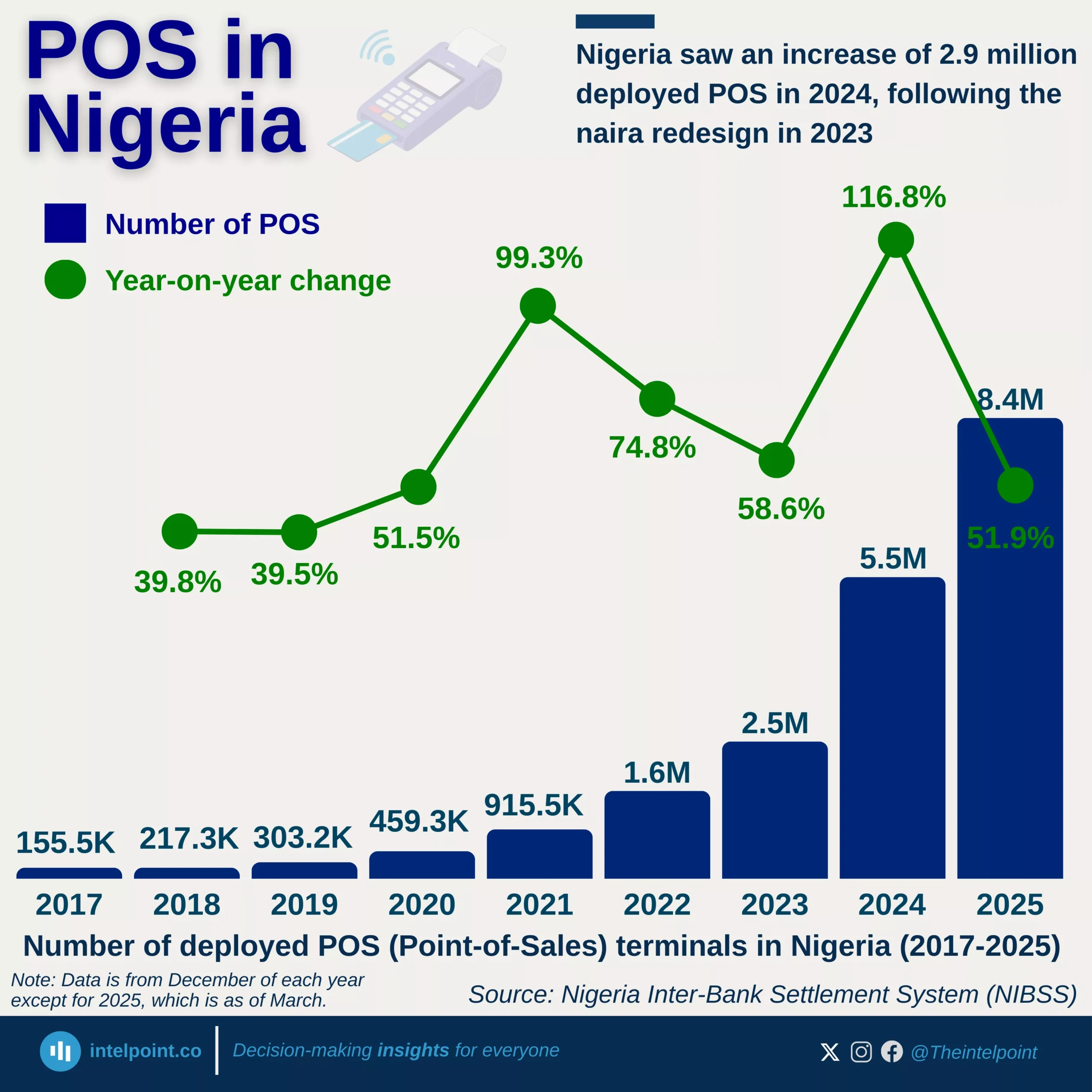
Nigeria's digital payments ecosystem has expanded rapidly over the past two years, driven by a cash scarcity crisis, rising smartphone penetration, and aggressive fintech competition. Nigeria had 8.36 million registered PoS terminals, with 5.90 million active and deployed as of March 2025, and transactions hit a record ₦10.51 trillion in the first quarter of 2025, a 301.67 percent increase from the same period in 2024, as agents became the primary gateway for cash.
That growth has also invited regulatory tightening. From April 1, 2026, Point of Sale agents must be exclusive to one principal, whether a bank, mobile money operator, microfinance bank, or payment service bank, under Central Bank of Nigeria guidelines released in October 2025. Analysts describe it as the most comprehensive regulatory overhaul since agent banking began in 2013. This shakes up the multiple terminal habits agents had relied on. A busy kiosk owner could previously keep a row of terminals on the table, reaching for whichever worked when a customer's card arrived. If one network struggled with settlement, another filled the gap. That flexibility will soon disappear.
Against this backdrop, PalmPay is competing with formidable rivals. OPay's agent network is often described as the broadest of any fintech platform in Nigeria, with presence in markets, motor parks, rural towns, and underserved urban neighborhoods, making its agent density difficult to match. Meanwhile, Moniepoint says it had deployed over one million terminals by 2025, processing ₦10 trillion in monthly transactions and accounting for roughly 80 percent of the country's PoS activity.
What Flipbz Thinks
Flipbz sees PalmPay's offline capability not as a side feature but as a genuine competitive differentiator in a market where trust, reliability, and physical reach often outweigh app design. As the new CBN exclusivity rule forces agents to commit to one principal partner, the fintechs with the deepest, stickiest offline relationships, not necessarily the flashiest apps, stand to gain long term loyalty. PalmPay's dual strategy of preloaded smartphone distribution combined with a vast human agent layer positions it uniquely to capture both connected and disconnected Nigerians simultaneously, a hybrid model that purely digital challengers will struggle to replicate quickly.
What Consumers & Investors Should Watch
Consumers should monitor how the April 2026 CBN exclusivity rule reshapes agent availability and reliability in their neighborhoods, since agent choice, not app features, may soon determine daily payment convenience. Investors, meanwhile, should track agent network growth rates, transaction success metrics, and PalmPay's expansion into new African markets as proxies for sustainable market share, particularly as the company reportedly explores new funding to support that growth.
The Bottom Line
In a market where cash still moves the majority of daily commerce, the fintech that wins offline may ultimately win everywhere. PalmPay's bet on agents, embedded hardware, and physical support networks could prove to be the quiet infrastructure play that decides Nigeria's next chapter of financial inclusion, long after the app download headlines fade.

Please register to comment.
With these components in place, your business...
SolidBase Builders Limited is a professionall...
PrimeStone Construction Nigeria Ltd is a well...
CrestRock Engineering Services Ltd is a scala...
Open the Listing model file located in the ap...
Discover promising partnership opportunities in various industries.
Pitch Your Startup | Find Partners

.jpg)
.jpg)
.jpg)
.jpg)





Comments