
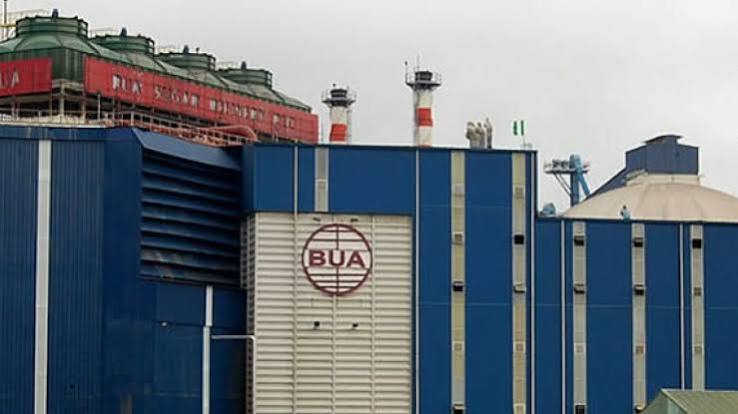
Written By: Flipbz.org
As BUA Foods expands production capacity across key food categories, the company is reinforcing the broader trend of large Nigerian manufacturers investing in domestic processing rather than relying heavily on imports.
BUA Foods is doubling down on domestic manufacturing capacity at a moment when Nigeria's broader industrial base is straining under high energy costs and tight financing conditions. While many manufacturers across the country describe a sector selling below cost simply to survive, BUA Foods has continued reporting strong revenue and volume growth, positioning its expansion strategy as a case study in how scale, backward integration, and diversified food categories can help large domestic producers weather Nigeria's difficult operating environment.
What Happened
BUA Foods reported revenue of ₦1.15 trillion for the first half of 2026, marking a 41 percent increase compared to the ₦815.9 billion posted in the corresponding period of 2025. The company's profit after tax rose to ₦221.5 billion for the six month period, while earnings before interest, tax, depreciation and amortisation reached ₦354.7 billion, reflecting continued growth momentum across its core product lines, according to the unaudited financial statement filed with the Nigerian Exchange.
That growth built on a strong first quarter. BUA Foods reported an unaudited pre-tax profit of ₦185.42 billion for the first three months of 2026, representing a significant 152.87 percent increase compared to ₦73.32 billion posted in the corresponding quarter of 2025, with revenue for the quarter rising to ₦577.66 billion from ₦395.36 billion a year earlier.
Company leadership has pointed directly to capacity investment as the driver behind this performance. BUA Foods Group Managing Director/CEO, Ayodele Abioye, said the results reflect the resilience of the company's diversified business model and continued execution of its strategic growth agenda, adding that the sustained growth across its major segments, sugar, flour, pasta, and edible oils, demonstrates the company's ability to scale operations while managing cost pressures effectively. The company has continued to invest in backward integration initiatives, including expanded sugar refining capacity and flour milling operations, aimed at reducing dependence on imported raw materials and strengthening long term supply chain resilience.
BUA Foods has also continued pursuing sugar sector self-sufficiency ambitions tied to Nigeria's National Sugar Master Plan, under which the company has committed to significant investment in backward integration for sugarcane cultivation and processing at its Bassa-Kwara sugar project, designed to reduce Nigeria's historical reliance on imported raw sugar. The company's broader capacity expansion strategy spans multiple food categories, with continued investment in edible oil refining and pasta production lines aimed at meeting rising domestic demand while limiting exposure to foreign exchange volatility tied to imported inputs.
Why It Matters
BUA Foods' expansion carries significance well beyond its own shareholders. As one of Nigeria's largest food manufacturers, the company's capacity investments directly affect domestic availability and, potentially, pricing stability for staple products including sugar, flour, and edible oils, categories that make up a significant share of household food spending. When large scale domestic producers expand backward integration, reducing dependence on imported raw sugar or wheat, the broader economy benefits from reduced foreign exchange exposure at the national level, since less foreign currency is required to import raw materials that can instead be sourced or processed domestically.
For Nigerian consumers already contending with elevated food inflation, the practical impact of expanded domestic capacity depends heavily on whether increased supply translates into more stable pricing over time, or whether input cost pressures elsewhere in the economy continue outweighing the benefits of localized production. BUA Foods' continued profitability growth, even as the broader manufacturing sector reports contraction, suggests the company has found a way to convert capacity investment into commercial resilience, a distinction that matters for assessing whether its model is genuinely replicable across Nigeria's wider industrial base.
Industry Context
BUA Foods' performance stands in notable contrast to the broader struggles described across Nigeria's manufacturing sector this year. Manufacturers in Nigeria are increasingly selling products below production cost in a desperate bid to clear nearly N2 trillion worth of unsold inventory, according to the Manufacturers Association of Nigeria, underscoring severe cost pressures and weak consumer demand confronting the country's industrial sector broadly. Against that backdrop, BUA Foods' sustained double digit revenue and profit growth illustrates a bifurcated manufacturing landscape, where large, well capitalized, vertically integrated producers appear better positioned to manage cost pressures than smaller operators lacking similar scale or backward integration capacity.
Nigeria's food manufacturing sector overall has continued grappling with the same structural challenges affecting industry broadly, including a monetary policy rate that has hovered around 26 percent, elevated energy costs following the diesel price surge tied to the Middle East conflict earlier in the year, and continued exchange rate volatility affecting importers of raw materials not yet substituted through domestic sourcing. Companies with established backward integration programs, sourcing sugarcane, wheat, or other raw inputs domestically rather than relying on imports, have generally proven more resilient to these pressures than manufacturers still dependent on imported feedstock subject to currency fluctuation.
This dynamic reflects a broader policy push the Nigerian government has pursued for years, encouraging large scale local manufacturers toward backward integration as a strategy for reducing the country's import dependence across key agricultural and industrial value chains. The National Sugar Master Plan specifically has aimed to reduce Nigeria's heavy reliance on imported raw sugar by incentivizing large scale domestic cultivation and refining investment from major players including BUA Foods and Dangote Sugar, positioning the sugar sector as a test case for whether backward integration policy can meaningfully shift Nigeria's import dependence over the medium term.
What Flipbz Thinks
Flipbz sees BUA Foods' continued expansion as a compelling counterpoint to the broader manufacturing distress narrative dominating Nigeria's industrial sector this year. While the Manufacturers Association of Nigeria has warned of firms selling below cost simply to clear inventory, BUA Foods has managed to grow both revenue and profitability substantially over the same period, a divergence that likely reflects the advantages of scale, diversified product categories, and years of accumulated backward integration investment that smaller competitors have not been able to replicate. The company's approach suggests that for large, well capitalized Nigerian manufacturers, the path through the current cost environment lies less in price cuts and more in structural investment aimed at controlling input costs directly. Whether this model can be meaningfully scaled down to benefit small and medium sized manufacturers, who lack the capital to pursue similar backward integration, remains one of the more important open questions for Nigeria's broader industrial policy.
What Consumers & Investors Should Watch
Consumers should watch whether BUA Foods' expanded domestic sugar, flour, and edible oil capacity translates into more stable retail pricing over time, or whether other cost pressures across the food supply chain continue to outweigh the benefits of reduced import dependence. Investors should track progress on the company's Bassa-Kwara sugar project and other backward integration initiatives tied to the National Sugar Master Plan, given their significance to the company's long term margin profile, alongside how BUA Foods' growth trajectory compares with peers like Dangote Sugar and Flour Mills of Nigeria as the broader food manufacturing sector continues navigating a difficult cost environment.
The Bottom Line

BUA Foods' continued capacity expansion offers a rare bright spot within a Nigerian manufacturing sector otherwise defined by contraction and distress in 2026. Whether the company's model, built on scale, diversification, and sustained backward integration investment, can serve as a genuine template for the broader industrial base, or remains an advantage available only to Nigeria's largest and most capitalized producers, will shape how policymakers think about the country's path toward reduced import dependence in the years ahead.

Please register to comment.
With these components in place, your business...
SolidBase Builders Limited is a professionall...
PrimeStone Construction Nigeria Ltd is a well...
CrestRock Engineering Services Ltd is a scala...
Open the Listing model file located in the ap...
Discover promising partnership opportunities in various industries.
Pitch Your Startup | Find Partners
.jpeg)
.jpeg)
.jpeg)
.jpeg)
.jpeg)



Comments